

BRENHAM ISD GIFTED AND TALENTED PROGRAM COULD SEE CUTS

Brenham ISD’s Gifted and Talented (GT) program could see a reduction in the amount of hours students spend in the program, as well as how many teachers are involved.
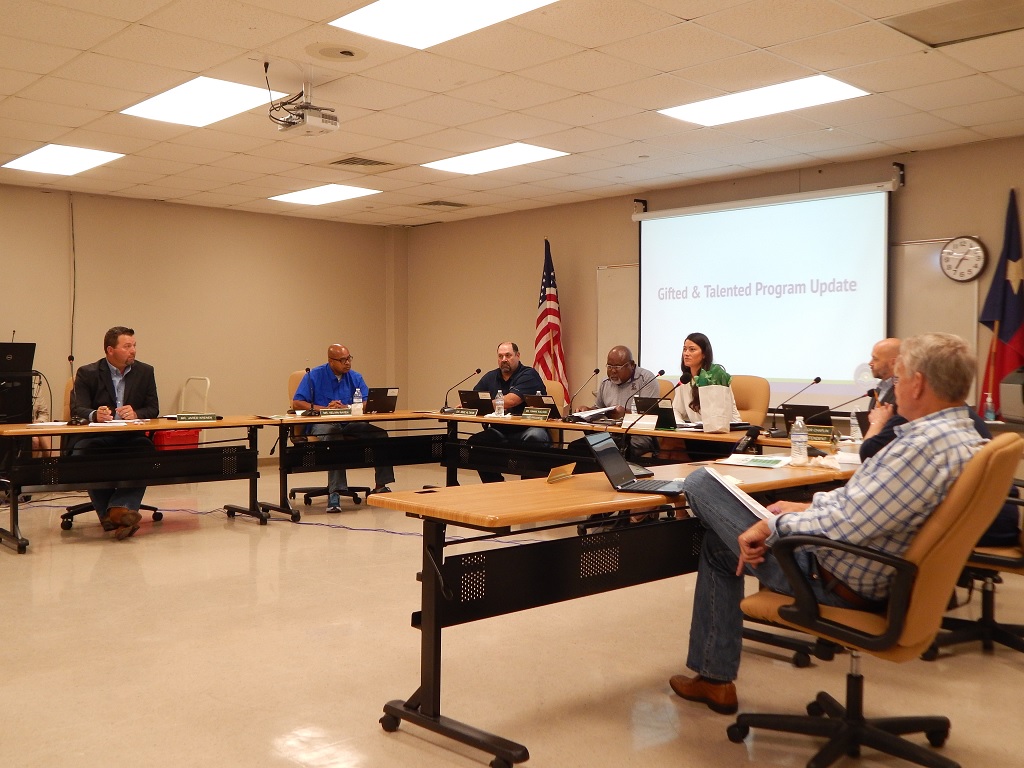 At Monday’s school board meeting, trustees heard a report from Special Programs and Advanced Academics Director Lori Ruiz-Wamble, who explained that there could be a shift to the Challenging Scientific Investigations (CSI) program, science and technology enrichment for students in grades 2-6.
The presentation shared by Ruiz-Wamble indicated that CSI students would go down to weekly two-hour enrichment lessons with one CSI teacher, who would travel to all elementary schools and have a home campus at Brenham Middle School. This compares to the 2019-20 school year, which had weekly five-hour enrichment with two teachers in grades 2-4 and three hours per week from core instruction in grades 5 and 6. During the 2019-20 school year, students would travel to and from Krause Elementary School for their enrichment lessons.
Superintendent Dr. Tylor Chaplin said the number of students in the program does not warrant the need for two teachers.
According to Ruiz-Wamble, the district currently has 344 GT students, about 7 percent of the overall student population. In comparison, she said GT students make up roughly 6 to 8 percent of the overall student population in Texas. She said the district generally averages 25 to 35 GT students per grade level.
Due to COVID-19, the CSI program during the 2020-21 school year featured weekly one-hour virtual lessons in the fall and one-hour face-to-face lessons with one teacher in the spring, with the CSI teacher travelling to each campus.
Dr. Chaplin said it needs to be noted that all students are behind in some way because of the pandemic, and that catching them up on core instruction is crucial.
Several trustees voiced their disappointment in the potential reduction and remarked on how creativity among students is often sparked in larger group settings. Board Secretary Susan Jenkins said Brenham ISD has been a leading district in the GT program, and believes a decision like this could ruin it quickly. She also argued that the students who are eligible for CSI would not need as much core instruction. Trustee Dr. Michael Altman suggested holding off on making major changes to the program until reviewing data from a non-COVID year.
Explaining how students are accepted into the GT program, Ruiz-Wamble explained that the district holds an annual screening process to identify GT students. Parents are able to nominate students to be screened for the program during a referral window, which she said is available in-person and online.
Ruiz-Wamble said in order to be compliant with the state, districts are required to provide access to assessment and provide services to all student populations. She said districts are put into a “recommended” category if the ethnicity of their GT population becomes more closely reflective of their overall student population over the past two years, and that Brenham ISD is considered part of that category. She said while the district has made positive incremental changes, it still has “a lot of room for growth in this area.”
Also at Monday’s meeting, Assistant Superintendent of Curriculum and Instruction Brandi Hendrix presented the board with an update on the district’s Special Education program. Hendrix stated that, according to the 2020 SPED Program Area Cut Points and Associated Determination Levels, Brenham ISD is one of 23 school districts—out of 1,202 in the state—with a Level 4: Needs Substantial Intervention mark in Special Education. She said Brenham ISD had a Level 1 rating the year prior, and that the lack of state accountability data last year is part of the reason for this.
According to Hendrix, there are 50 to 60 students per grade level in the district who qualify for Special education services in grades 2-12, and there are 780 students in total—about 15 percent of the student population—who receive those services.
Hendrix said the district missed three results-driven accountability targets for Special Education. The state requires 70 to 100 percent of students to be in general education classes for 80 percent of the day; Hendrix said the district only had 44.6 percent of students at that threshold. The state allows up to 10 percent of students to spend less than 40 percent of their day in a general education classroom; according to Hendrix, the district had 27.8 percent of students at that mark. In addition, the state allows districts to remove students from their placement at a rate of 19 percent; Hendrix said the district removes Special Education students from their regular placement to disciplinary alternative education programs (DAEP), in-school suspension or out-of-school suspension at a rate of 94 percent.
The district’s corrective action plan includes meetings on each campus to determine student placement for the upcoming school year, as well as the implementation of a professional development plan for inclusive practices. Hendrix said professional training has been difficult to accomplish due to the lack of substitute teachers available to fill for full-time teachers who need training, but there are some training sessions scheduled this summer.
Trustees also heard from Curriculum, Instruction and Accountability Director Sarah Cook, who discussed how the district plans to close the learning gap caused by COVID-19 for the 2021-22 school year. Cook said some goals to close the gap include providing professional development to build capacity in all staff; reducing the student to teacher ratio by staffing early elementary grades at 16 to 1; establishing a Reading Horizons Phonics program for grades K-3, while having Pre-K through 4th grade teachers attend reading academies during the 2021-22 school year; having counselors provide social and emotional learning; providing in-class support by certified teachers to serve special populations; creating master schedules to provide collaborative planning time for teachers and time for research-based intervention and extension for student learning; expanding and improving upon current programs and practices to better serve the student population; and continuing to provide extended day services for intervention.